
What Is Computer Simulation Technology?
In today’s world, computer simulations are everywhere. From designing airplanes to predicting storms or helping doctors practice surgery, simulations make complex tasks safer, faster, and cheaper. This article explains what computer simulation technology is, how it works, and why it is becoming more important every year.
which may be costly and risky or time-consuming. Simulations reproduce reality using mathematical models and computer algorithms whether it is in designing an airplane, forecasting the weather or training medical students.
Why Computer Simulation Matters Today
-
Tesla and self-driving cars: Their software is trained using millions of simulated driving hours.
-
Hospitals and surgery training: Doctors practice complex operations using VR simulations.
-
Weather forecasting: Scientists simulate storms and rainfall before they happen.
-
Video games: Open-world games use physics simulations to make movement and environments feel real.
It has been integrated into the practice of engineering, health care, defense, entertainment and more.
Evolution of Computer Simulation Technology
Early Stage Simulations
-
1950s: First military and scientific simulations
-
1970s: Weather forecasting computers
-
1990s: Rise of 3D engineering and design simulations
-
2000s: Growth of high-performance computing
-
2020s: AI-based models, VR simulations, and digital twin
Mechanical testing and related concepts such as wind tunnels were not a recent invention, however, with the advent of digital simulation everything was different.
The Rise of High-Performance Computing
Digital Twins
Digital Twins
A digital twin is a virtual copy of a real object, machine, or system. It updates in real time using sensors and data.
Examples:
-
Smart factories
-
Building safety monitoring
-
Car design
-
Healthcare devices
Digital twins help predict problems before they happen and make systems work better.
AI and Machine Learning in Simulations
The use of AI and ML led to the development of more realistic simulations through the analysis of massive datasets and the development of prediction models.
Such technologies enable simulations to learn and modify automatically, and the results are more trustworthy and realistic.
How Computer Simulations Work
Input Data Collection
Every simulation starts with accurate data environment conditions, physical properties, measurements, and assumptions.
Steps to Create a Simulation:
Define the goal of the simulation
Collect accurate data about the system
Build the mathematical or physical model
Run the simulation on a computer
Compare the results with real-world data and improve the model
Mathematical and Physical Modeling
These inputs are then transformed into mathematical models. Algorithms predict how objects behave and interact.
Execution and Visualization
The simulation is run on a computer system, and results are displayed through graphs, 3D models, animations, or performance charts.
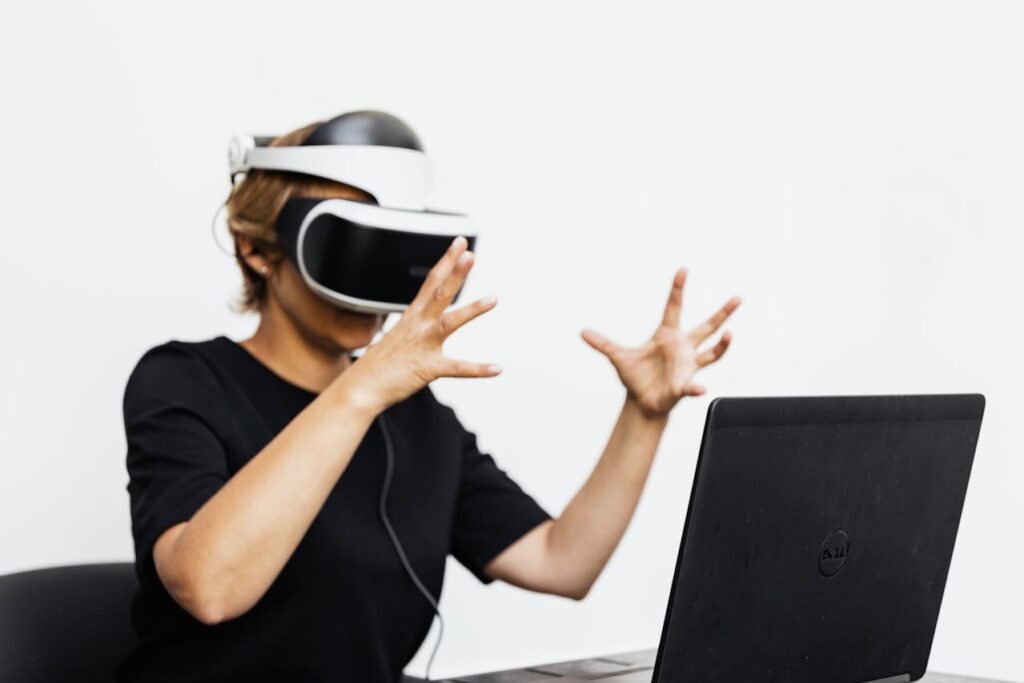
Modern software even supports immersive visualization using VR headsets.
 Types of Computer Simulations
Continuous Simulation
Used for systems that change constantly over time—like climate models or temperature changes.
| Type | What It Is Used For | Difficulty | Best For |
|---|---|---|---|
| Continuous | Weather, temperature | Medium | Scientific studies |
| Discrete Event | Factories, logistics | Low | Business operations |
| Agent-Based | Crowd behavior, economics | High | Social science models |
| Hybrid | Traffic, large systems | Very high | Engineering and city planning |
Discrete Event Simulation
Used for operations divided into steps or stages, such as manufacturing assembly lines.
Agent-Based Simulation
This type uses individual entities (“agents”) that act on rules. Common in economics, social sciences, and crowd behavior studies.
Hybrid Simulation Models
A combination of multiple simulation types used to solve complex problems, such as traffic flow or large-scale engineering systems.
Applications of Computer Simulation Technology
Engineering and Manufacturing
Product Design and Prototyping
Simulation lets engineers test product designs virtually before creating physical prototypes—saving time and reducing manufacturing errors.
Stress and Reliability Testing
Simulations can test whether a building can handle earthquakes or if a bridge can survive heavy load—without putting lives at risk.
Healthcare and Medical Research
Doctors use simulations for surgical training, drug testing, and medical imaging. This helps reduce risks and improves patient outcomes.
Climate Science and Environmental Studies
Climate models simulate environmental changes, predict natural disasters, and study global warming patterns.
Education and Training
Simulated labs, flight simulators, and VR classrooms help students learn complex concepts safely and interactively.
Aerospace and Defense
Simulations are used to train pilots, test aircraft designs, run battlefield scenarios, and predict mission outcomes.
Gaming and Virtual Reality
Video games and VR experiences rely heavily on physics simulation, character motion, and environmental modeling.
Benefits of Using Computer Simulations
Cost Reduction
No need for expensive prototypes or physical testing.
Time Efficiency
Simulations deliver results faster than real-world experimentation.
Risk Elimination
Simulating dangerous scenarios keeps people safe—especially in defense, aerospace, and medical fields.
Better Decision-Making
Using simulation data, businesses and researchers can make more informed decisions.
Challenges in Computer Simulation Technology
Model Complexity
Designing accurate models requires expertise and advanced tools.
Accuracy of Inputs
Wrong inputs mean wrong predictions. Data quality is crucial.
High Computing Costs
Some simulations require powerful servers or supercomputers.
Data Limitations
Incomplete or outdated data affects simulation accuracy.
Future of Computer Simulation Technology
Predictive Simulations
Predicting future events—from disease outbreaks to market trends—will become more accurate.
AI-Driven Modeling
AI will automate model creation and calibration, reducing time and increasing accuracy.
Real-Time Simulations
Thanks to powerful processors, simulations will run instantly, even on portable devices.
Quantum Computing in Simulations
Quantum computers will handle complex simulations that traditional computers struggle with—potentially transforming industries like medicine and climate science.
Advantages of Simulation:
-
Lower cost
-
Reduced risk
-
Faster results
-
Better decisions
Challenges of Simulation:
-
Models require expert knowledge
-
Wrong input results in wrong predictions
-
Some simulations need powerful computers
-
Limited or old data can reduce accuracy
Tools for Beginners
-
MATLAB / Simulink – Used in education and engineering
-
ANSYS / COMSOL – For engineering and physics simulations
-
SolidWorks Simulation – For product testing and prototyping
-
Unity / Unreal Engine – For gaming and VR simulations
-
Python (NumPy, SciPy, SimPy) – Free tools for smaller models
Conclusion
The technology of computer simulation has become one of the strongest means of contemporary science and industry. It saves time, lowers costs, eradicates risk, and contributes to making informed decisions.
With the further development of AI, machine learning, and quantum computing, simulations will get even more sophisticated and inevitable.
Simulations are making the future, whether it is in engineering, medicine, or even in gaming or aerospace, and they are doing it at a faster rate than ever before.
FAQs
1. What is computer simulation technology used for?
It’s used in engineering, healthcare, education, aerospace, gaming, and research to analyze and predict outcomes without real-world experimentation.
2. Why are simulations important?
They reduce cost, improve safety, save time, and help in making better decisions.
3. What tools are used for simulations?
Popular tools include MATLAB, ANSYS, SIMULINK, SolidWorks Simulation, and COMSOL Multiphysics.
4. Can simulations replace real-world experiments?
Not entirely, but they significantly reduce the need and provide valuable insights before actual testing.
5. What is the future of simulation technology?
AI-powered, real-time, and quantum simulations will dominate the future, increasing speed and accuracy. if you have any Question about Us!
[…] In conclusion, transactions on mobile computing play a major role in how people use their mobile devices today. When transactions on mobile computing are secure and stable, users trust apps and enjoy a better experience. As technology continues to improve, businesses will work even harder to make transactions on mobile computing faster and safer for everyone. This makes the future of mobile services strong and full of growth. If You want to read about Computer simulation Technology […]